The Lofoten Islands explained
Published 15 September 2026
Norway's most dramatic destination explained
The Lofoten Islands sit some 100 miles inside the Arctic Circle, off Norway's north-western coast, where a chain of granite peaks rises almost directly out of the sea. Clients considering them are usually comparing them against the western fjords or a North Cape itinerary, and the honest answer is that Lofoten is a different kind of Norway — smaller in scale, more concentrated, and built around fishing villages rather than cruise ports. The five points below cover what a client actually needs to know before booking.
What does the scenery actually look like?
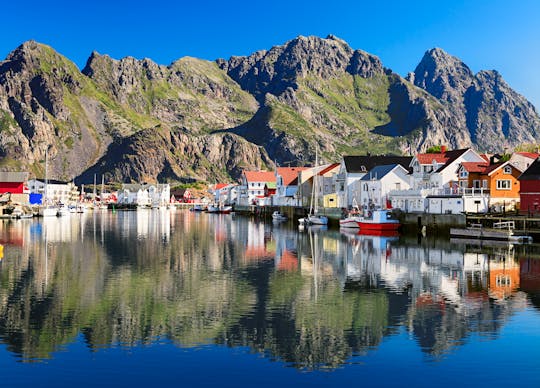
Lofoten's peaks rise straight from the water without foothills, so even a short drive along the E10 moves between sheer rock faces, white-sand bays and red-painted fishing villages within a few miles. The islands are compact — Austvågøya, Vestvågøya, Flakstadøya and Moskenesøya are linked by road and bridge — which means a client can cover striking, varied scenery without long transfer days. It photographs dramatically, but the appeal for most of our clients is quieter than that: working harbours, drying racks for stockfish, and a landscape still shaped by fishing rather than tourism.
When should we travel?
Lofoten works in two quite different registers depending on season. Midsummer (late May to late July) brings the midnight sun and long, usable days for hiking and boat trips, alongside the archipelago's busiest period. Winter (typically late September to March) is the more specialist trip — shorter days, harder weather, but a genuine chance of the aurora against a mountain backdrop, and villages such as Henningsvær and Reine at their most atmospheric. Spring cod-fishing season (February to April) is a distinct draw of its own, when the racks are hung with drying fish and the working character of the islands is most visible.
How do we get there, and is it hard to get around once there?
The usual route is a flight to Oslo, a connection to Bodø or Harstad/Narvik, and either a short onward flight to Svolvær or Leknes, or the more scenic option of the Hurtigruten coastal ferry into Svolvær. Once on the islands, a hire car is the practical way to see them — the E10 runs the length of the archipelago and distances are short, though winter driving requires proper preparation. For a client who would rather not self-drive, we can build the itinerary around private transfers and a base in one or two villages rather than constant movement.
What's the accommodation actually like?
The distinctive option is a rorbu — a traditional fisherman's cabin, usually on stilts over the water, now converted to comfortable self-catering or hotel-style use in villages such as Svolvær, Reine and Henningsvær. Standards vary considerably between operators, so we work only with properties we have vetted for genuine comfort rather than rustic in name only. For clients who prefer a conventional hotel, Svolvær and Leknes have small but well-run options; either way, Lofoten is not a resort destination, and room counts in the best villages are limited, particularly in July.
How long should we allow, and does it combine well with the rest of Norway?
Four to five nights is enough to see Lofoten properly without rushing — a night or two each in the Svolvær area and further south around Reine or Å covers the range of scenery. It pairs naturally with a few nights in Bergen or the western fjords before or after, or with Tromsø for clients travelling in winter who want a second, more urban base for aurora viewing. We would not recommend Lofoten as a single-centre first trip to Norway; it rewards clients who have already done the fjords once and want somewhere more remote for a second visit.
Planning a Lofoten Islands holiday with Expressions Holidays
The five points above are a starting framework rather than a fixed itinerary — we regularly extend a Lofoten stay with a few nights in Tromsø or the fjords, or build it as a dedicated Arctic trip in its own right for clients travelling in winter.
To begin planning, call us on 01392 441245 Monday to Friday 9am to 5.30pm, Saturday 10am to 2pm, or email info@expressionsholidays.co.uk