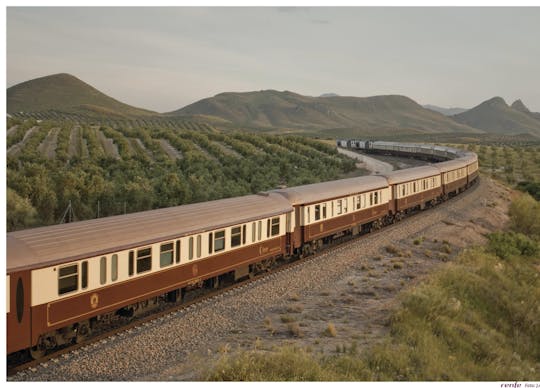
The Al Andalus
Published 16 September 2026
Spain's luxury train and what makes it extraordinary
Ask what the Al Andalus is like, and the honest answer is: less like a train journey and more like a small hotel that changes its address every night. Spain's best-known heritage train is a set of Belle Époque carriages, once built for the British royal family's journeys between Calais and the French Riviera, now running loops through Andalusia, Extremadura and Castile. Guests do not spend the day watching scenery scroll past a window, as they might on an Alpine rack railway; they spend it off the train entirely, on guided visits to Córdoba, Cádiz, Mérida or Toledo, and return each evening to dinner served in a restaurant car with white tablecloths while the train moves on to the next stop overnight.
That is the central fact worth knowing before anything else: the Al Andalus is built around towns, not landscape. Anyone expecting the visual drama of Switzerland's Glacier Express or Norway's Flåm line will be looking out of the wrong window for most of the week. What the Al Andalus does instead is remove the logistics of a touring holiday, no repeated packing, no transfers between hotels, no taxis to dinner, while delivering a fairly intensive programme of museum visits, guided walks and excursions each day.
Is it worth doing? For travellers who want that particular trade, formality and structure in exchange for zero logistical friction, yes, and few alternatives in Spain offer it as completely. For travellers who want flexibility, spontaneity, or scenery as the main event, a self-drive or chauffeured touring holiday through the same region will usually suit better, and cost less.
Most people picture the Al Andalus from a handful of photographs: mahogany panelling, a waiter in white gloves, a train sliding past whitewashed villages at golden hour. A well-planned trip on it looks different in practice, an unhurried, fairly formal week with a fixed schedule, best suited to travellers who have chosen the right season and cabin category deliberately, rather than assumed the postcard image will simply happen to them.
What the Al Andalus actually is
The train's four heritage carriages, a restaurant car, bar car, lounge and tea room among them, were built in France between 1928 and 1930 for the British monarchy's journeys from Calais to the French Riviera. Spain's national railway later acquired them, and in the mid-1980s converted them into a dedicated tourist train under the name Al Andalus Expreso. The service ran until 2005, when its then-operator went into administration and the carriages sat unused at Seville's San Pablo station for several years before returning to service under Renfe in 2012. Today the train carries a maximum of 64 passengers across 32 cabins split between two categories, twin-bedded Gran Clase cabins and slightly larger Deluxe Suites with a double bed and a steam shower, plus onboard Wi-Fi and a small lounge car. It runs on standard gauge, unlike Spain's narrow-gauge northern heritage trains, and operates seasonally between April and October.
What a day on board is actually like
A typical day starts with breakfast, either a buffet on board or at a local restaurant once the train has arrived overnight at its next stop. A multilingual guide then leads a morning excursion, a cathedral, a bodega, a Roman site, with lunch either back on the train or, on some days, at a restaurant en route. Afternoons bring a second excursion before the train departs in the early evening, so dinner is usually served on board as the carriages move toward the following morning's town. Because nearly all onboard activity happens while stationary or overnight, and because cabins are converted from day lounges to beds by the crew each evening, guests never handle luggage between stops, the closest experience in mainland Spain to a small cruise ship on rails. The trade-off is a set daily rhythm: departure and arrival times, excursion slots and meal sittings are fixed for the group, with limited scope to skip an activity and do your own thing instead.
Addressing the obvious doubt: is it worth it?
The most common hesitation is price. Expressions' current itinerary starts from roughly £7,150 per person in a Grand Class cabin, rising past £8,300 for a Deluxe Suite, for what is, cabin for cabin, compact accommodation, closer in size to a sleeper compartment than a hotel room. A land-based touring holiday covering the same towns and staying in four- and five-star hotels would typically cost less for more space and more free time. The second hesitation is pace: because excursions and meals run to a shared schedule, the week suits travellers who are comfortable with structure rather than those who want to linger an extra hour in a museum or skip a visit for a long lunch alone. Alcohol beyond the included wine, laundry and any additional excursions are charged separately. None of this makes the Al Andalus poor value for the right traveller; it simply means the appeal lies in the format and the setting, not in efficiency or flexibility.
How it fits into a wider itinerary
Because the train runs to a fixed one-week schedule, most guests build additional nights around it rather than treating it as the entire holiday. Expressions' own itineraries typically add a night in Seville before boarding and a night in Madrid on arrival, giving time to settle in and see each city properly beyond the train's brief stops there. Some travellers extend further, combining the week on board with independent touring elsewhere in Andalusia, a stay on the Costa del Sol. It is less commonly paired with beach time immediately either side, since the pace and formality of the train and a relaxed coastal stay tend to sit awkwardly back-to-back; a city stay or further cultural touring is usually a better match.
How to do it well, versus how most people do it
Most bookings simply take whichever fixed departure fits the traveller's available dates, in the standard cabin category. Doing it more deliberately means a handful of small decisions: choosing an April, May or June departure, or September or October, rather than the height of summer, when Andalusian heat can make daytime excursions considerably harder going; booking the Deluxe Suite where the extra space and steam shower genuinely change the week, rather than treating it as a minor upgrade; and adding at least one night in Seville and Madrid beforehand and afterward, rather than arriving on the morning of departure, so a missed flight or delayed bag doesn't jeopardise the first day.
Who it suits, and who might skip it
The Al Andalus tends to suit travellers who enjoy formality, structure and cultural immersion, and who would rather not drive or manage logistics themselves, it works well for a couple marking an anniversary, or friends who want a shared, sociable week without organising it. It suits people who are realistic about the pace: this is a week of guided visits and set mealtimes, not a flexible touring holiday. It is a poorer fit for travellers who want dramatic scenery as the main event, the landscape here is agreeable rather than spectacular, who dislike fixed schedules, or who would rather spend the same budget on more spacious accommodation and more free time. Travellers who feel restless in enclosed spaces should weigh the compact cabins carefully before booking.
How Expressions organises it
Expressions books the Al Andalus as part of a tailor-made itinerary rather than a fixed package: choice of route and direction, cabin category, and additional nights and hotels in Seville and Madrid, either side of the train. Private transfers are arranged between airport, hotel and the train's departure point, and the whole booking, flights, hotels, transfers and the train itself, is handled by a single consultant rather than split between separate suppliers. This matters in practice on a holiday with several moving parts and a fixed departure date: if a flight is delayed or a connection needs adjusting, one point of contact can manage the change without the traveller having to coordinate between the train operator, hotels and airline separately.