Our bespoke, luxury hotel holidays can be
● Single centre or multi-centre● Long or short stays
● Combine a number of different hotels in different regions
● Utilise a variety of transport arrangements to Italy and within Italy, combining flights, hire-car, rail, ferries and private transfers
Our special interest holidays to Abruzzo
● Cultural tours for individuals● Visits to local music festivals
● Private guided sightseeing
Included in all our holidays
● Concierge service● Handcrafted helpful hints and local information provided with all our holidays
● Personal service by your sales consultant who looks after all aspects of your holiday
Call us on 01392 441245
Highlights of Abruzzo
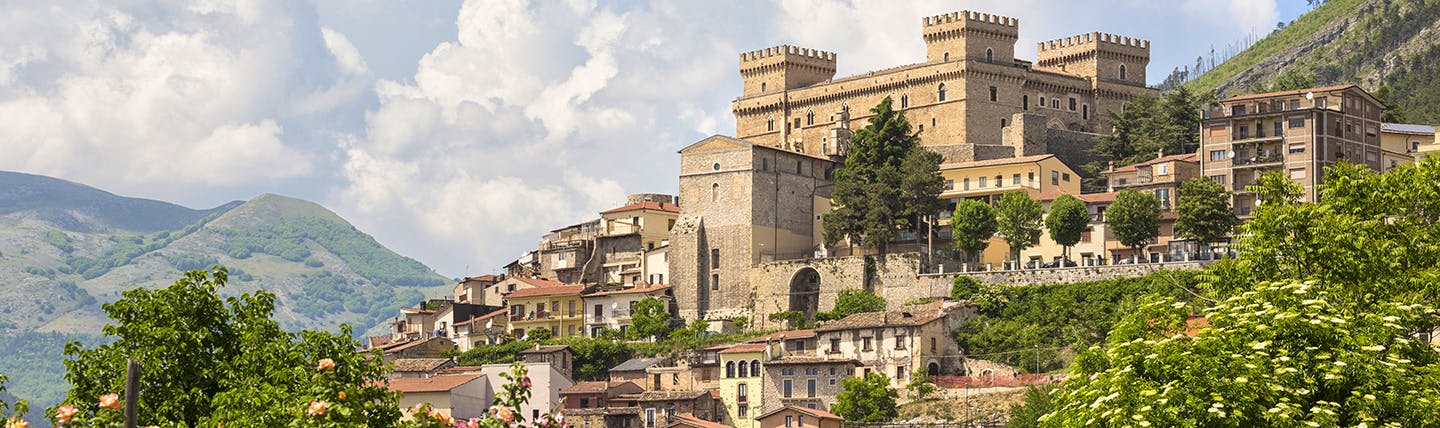
Mediaeval castles abound, with Pescina, San Pio delle Camere, Celano and Ocre merely some the most spectacular; wandering the winding streets of the dramatic castle towns of Castel di Ieri and Fontecchio; Maiella National Park, with its 40 hermitages and chapels, wild-flower valleys and forests, and Gran Sasso (9,554ft), the highest summit on the Italian peninsula; the ski resort of Pescocostanzo, complete with 16th century palaces and 11th century churches; Ovid's birthplace, Sulmona, a pretty medieval town in the shadow of Gran Sasso, with a 13th century aqueduct still supplying water to the town's fountain, a stunning 11th century cathedral with Byzantine-style reliefs; 1s
t century Roman ruins of Alba Fucens; Gole di Celano, a 2,000ft gorge, with a twisting, dramatically narrow, well-marked track at its base; Ovindoli, a charming hilltop village and wonderful base for hikes and rides into Velino-Sirente Regional Park, where visitors can walk alongside an underground river at Stiffe past spectacular rock formations, giant stalactites, stalagmites and spectacular subterranean waterfalls; Castelli, another classic hill-town with vast views over the valley below Gran Sasso, famed for its contemporary art shops; the 9th century cathedral of Atri and its magnificent Renaissance frescoes; an abundance of monasteries clinging to the cliffs, including the baroque churches and 15th century cloisters of San Giuliano overlooking L'Aquila.
Abruzzo travel information
Abruzzo is reached very easily from the UK by air and rail. We can arrange for you to travel by train with overnight stops. Some clients choose to take their own car all the way.By air
Daily flights to Rome with British Airways from Heathrow and Gatwick, or daily flights to Rome with Alitalia from Heathrow. Collect your hire-car on arrival.Car hire
We include a hire-car with all our holidays to Abruzzo as you really do need a car to make the most of your holiday in this region.Rail travel
You can take the Eurostar to Paris and then the overnight sleeper to Rome. Perhaps stay in Rome first and then collect your hire-car for your stay in Abruzzo.Self-drive
With your own car we recommend at least two overnight stops in each direction, possibly three one way at least, perhaps in Alsace, the Italian Lakes and Tuscany. Let us advise you on an itinerary and make the arrangements for you.Our bespoke, luxury hotel holidays can be
● Single centre or multi-centre● Long or short stays
● Combine a number of different hotels in different regions
● Utilise a variety of transport arrangements to Italy and within Italy, combining flights, hire-car, rail, ferries and private transfers
Our special interest holidays to Abruzzo
● Cultural tours for individuals● Visits to local music festivals
● Private guided sightseeing
Included in all our holidays
● Concierge service● Handcrafted helpful hints and local information provided with all our holidays
● Personal service by your sales consultant who looks after all aspects of your holiday
Call us on 01392 441245
Our bespoke, luxury hotel holidays can be
● Single centre or multi-centre● Long or short stays
● Combine a number of different hotels in different regions
● Utilise a variety of transport arrangements to Italy and within Italy, combining flights, hire-car, rail, ferries and private transfers
Our special interest holidays to Abruzzo
● Cultural tours for individuals● Visits to local music festivals
● Private guided sightseeing
Included in all our holidays
● Concierge service● Handcrafted helpful hints and local information provided with all our holidays
● Personal service by your sales consultant who looks after all aspects of your holiday