Sigiriya Rock Fortress
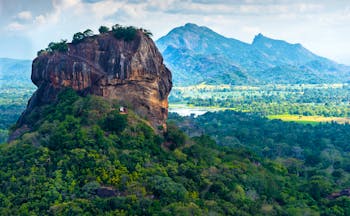
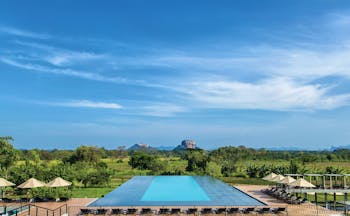
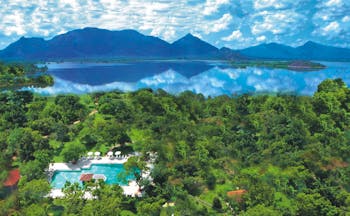
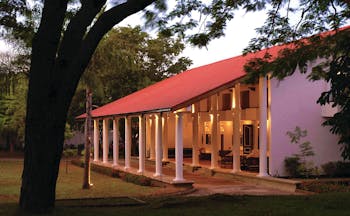
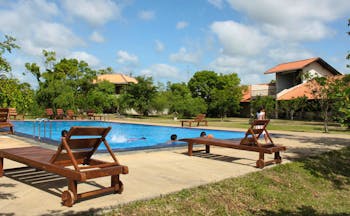
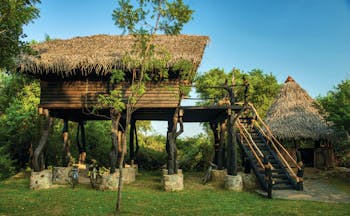
The 5th century Sigiriya Rock Fortress (also known as Lion Rock due to the huge lion that used to stand at the entrance to the palace), is one of the island's most awe-inspiring archaeological sites and its prime tourist attraction. For just two decades in the 5th century AD, the king set up his capital at Sigiriya; his creation was a remarkable feat of engineering and a true work of art. You can stroll through the ruins of the palace and gardens down below and admire the rock, but to fully appreciate Sigiriya it is worth climbing up the steep steps that take you up one side of the rock to reach the summit. At the top, there are majestic views of the surrounding jungle and the foundations of a Royal Palace, whilst on one of the stairways part-way up the rock, you will find ancient frescoes of 21 life sized damsels (believed to be the king's concubines), still shining in their original colours. Where to stay: Jetwing Vil Uyana, an eco-friendly luxury resort with views in the distance of Sigiriya Rock Fortress or Elephant Corridor, an all-suite boutique hotel with stunning views.
Cave temples of Dambulla
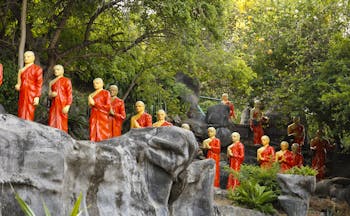
Hewn into a 160m granite outcrop are the remarkable cave temples of Dambulla. Used as a refuge since the 1st century BC, each cave is filled with murals depicting scenes from the Buddha's life and gilded statues of the Buddha in various poses. The temple is spiritual and mesmerising with no less than 150 Buddhist statues in the five caves. Cave 2, the Maharaja Vihara, is the largest and most spectacular. This visit involves a 10-15 minute uphill climb on foot, though you are also rewarded with wonderful views looking over the plain.
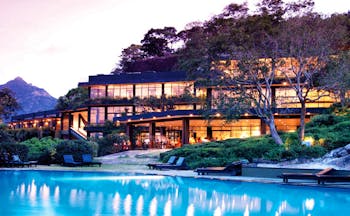
Where to stay: Heritance Kandalama, an award-winning eco-resort designed to resemble a natural extension of the mountainside or Kassapa Lion's Rock, a comfortable hotel where culture blends with nature and adventure.
Mediaeval capital of Polonnaruwa
In the 12th century AD, the capital of Polonnaruwa was one of the great urban centres in South Asia. Today, the well-preserved ruins give you the chance to experience the grandeur of this period and marvel at the artistry of the island's early craftsmen. Highlights include the Royal Palace and Council Chamber, and the four graceful Buddha statues of Gal Vihara (Stone Temple), the pinnacle of Sri Lankan rock carving. The site also hosts the Royal baths and the vast artificial Parakrama Samudraya reservoir (Sea of Parakrama) as well as many distinctly South Indian-style Hindu temples. Set amongst gently undulating woodland, the monkeys, giant lizards and birdlife in abundance, Polonnaruwa's historical site is visited using a combination of driving and on foot; or else hire a bike and cycle around (best visited early morning or late afternoon because this is the dry zone).
Where to stay: The Deer Park Hotel, a jungle hideaway which blends traditional and contemporary styles.
The sacred city of Anuradhapura
The ancient city of Anuradhapura is a vast ancient archaeological site of palaces, monasteries, temples and dagobas, mostly in ruins though some have been restored. This was once one of the grandest monastic cities the world has ever seen, established in the 4th century BC then rising to become the major centre for Buddhist pilgrimage and learning in Sri Lanka. It is home to the 2,300-year-old sacred bo tree, the Sri Maha Bodhiya, which was brought by Sangamitha Theri as a sapling from the bo tree in India under which Buddha attained enlightenment. The great kings of Anuradhapura oversaw a golden age in the island's history, building colossal dagobas that rivalled the pyramids of Egypt in scale, and developing a sophisticated irrigation system consisting of vast reservoirs and canals scattered across a 250 square kilometre area that are still in use today. The Jethawanaramaya Stupa is one of the largest ancient monuments in the world, a remarkable feat of engineering. Anuradhapura eventually fell into decline in the 10th century AD, enduring frequent invasions from India. A thriving town has grown up next to the ancient site and both remain an important centre for Buddhism, welcoming pilgrims and monks throughout the year, especially at full moon festivals. Due to the vast scale of the ancient city and the hot weather, people usually drive to the various sites, maybe walking between a few of them. You can hire bicycles to cycle around, best done in the early morning and late afternoon.
Where to stay: Ulagalla Resort, a 200 year old mansion with a distinctive character.
Mihintale Sanctuary
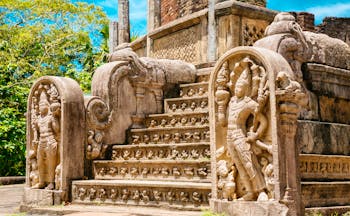
Clearly visible sitting on ‘the hill of Mahinda', 8 km from Anuradhapura, lies Mihintale sanctuary. Known as the ‘cradle of Buddhism in Sri Lanka', it was here that the Buddhist doctrine was first preached by the monk Mahinda, son of Asoka, Emperor of India, to King Devanampiyatissa more than 2,000 years ago. Mihintale has been a sanctuary since 247 BC and some of the Brahmi inscriptions found here date back to 3 BC. It is approached by a magnificent, wide, ancient stone stairway of 1,840 steps.
Where to stay: Ulagalla Resort, an eco-friendly resort set amongst paddy fields and lakes.
Our bespoke, luxury hotel holidays can be
● Single centre or multi-centre● Long or short stays
● Combine a number of different hotels in different regions
● Utilise a variety of transport arrangements to Sri Lanka and within Sri Lanka, combining flights, rail, and private transfers
Our special interest holidays to Sri Lanka's Cultu
● Cultural tours for individuals● Cookery
● Visits to local festivals
● Private guided sightseeing
● Safari and wildlife experiences
● Scenic train travel
● Family holidays
● Eco experiences
● Ayurveda and other spa holidays
● Walking and cycling
● Bird-watching
● Garden visits
Included in all our holidays
● Concierge service● Handcrafted helpful hints and local information provided with all our holidays
● Personal service by your sales consultant who looks after all aspects of your holiday
Call us on 01392 441245
Highlights of the Cultural Triangle
Sigiriya Rock Fortress; Dambulla Cave Temples; Polonnaruwa – ruins of the ancient capital; Anuradhapura – sacred city; Wildlife safari in Minneriya National Park (or Kaudulla National Park); Elephant rides/treks; Birdwatching on the ‘tanks’; Hot air balloon ride; Cycle ride – local village life; Ayurveda health treatments, massages, herbal steam beds and aromatic baths; Ritigala monastery ruins (walking required); Aukana Buddha; Mihintale; the story of Buddhism; the story of Ayurveda. Day trip or continue on to Kandy, visiting spice gardens, batik workshops, Temple of the Tooth, Kandy market, city centre, view from hills, workshops for woodcarving, brass and musical instruments.
Cultural highlights of the Cultural Triangle
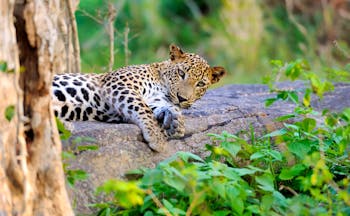
Four of Sri Lanka's eight UNESCO World Heritage Sites are in what is popularly known as the Cultural Triangle. Between them they tell a fascinating story of Sri Lanka’s civilisation. The 5th century Sigiriya Rock Fortress is one of Sri Lanka’s most awe-inspiring archaeological sites and its prime tourist attraction, well worth climbing to see the majestic views from the summit. Nearby are the Dambulla Cave Temples, each cave filled with murals and gilded statues depicting the life of the Buddha. The well-preserved ruins of Polonnaruwa, the 12th century capital, tell a story of Buddhism, royalty, kinship, war and power. Highlights are the Royal Palace, Council Chamber and four graceful Buddha statues of Gal Vihara. The ancient city of Anuradhapura is a vast archaeological site of palaces, monasteries, temples and dagobas, mostly in ruins, although some have been resorted. This was one of the grandest monastic cities that the world has ever seen. Other sights worth seeing are Mihintale Sanctuary, known as the ‘cradle of Buddhism in Sri Lanka’; Ritigala, ruins of a 9th century monastery hidden amongst dense forest; and Minneriya National Park, a park filled with wildlife including elephants, buffalo, wild boar and crocodiles.
Festivals in the Cultural Triangle
The Buddhist festivals: monthly on Poya (full moon) days, especially Vesak (May) and Poson (June). Poson marks the introduction of Buddhism to Sri Lanka by Arahat Maha Mahinda, son of Asoka of India at Mihintale in 3rd century BC. July to October – the Elephant Gathering: during this season in the evenings, hundreds of wild elephants gather along the banks of the Minneriya Tank.
Climate in the Cultural Triangle
As the climate is very hot with an average temperature of 30° C, it is best to do sightseeing and activities in the early mornings and late afternoons, with time to relax at the hotel, eat or travel in air-conditioning at the height of the day. Average humidity is 60%, with very little rainfall most of the year - most of the rain falls between November and February when the North-east monsoon prevails.
Cultural Triangle travel information
Sri Lankan Airways operates daily flights to Colombo from London Heathrow. Most flights leave London in the afternoon or evening. Flight time is about 11 hours. From Colombo you can also take the Sri Lankan air taxi to regional centres throughout the country.Travel around the region
We include private transfers with all our holidays to Sri Lanka, and a personal chauffer with all our touring holidays. Driving Distances: Colombo to Sigiriya – (170 km) 4 hours, International Airport to Sigiriya – (153 km) 4 hours, Dambulla to Sigiriya – (24 km) 30 minutes, Dambulla to Polonnaruwa (70 km) 2 hours Polonnaruwa to Anuradhapura – (100 km) 2.5 hours, Sigiriya to Anuradhapura – (82 km) 2 hours, International Airport to Anuradhapura – (170 km) 4.5 hours, Sigiriya to Kandy – (92 km) 2.5 hours.Our bespoke, luxury hotel holidays can be
● Single centre or multi-centre● Long or short stays
● Combine a number of different hotels in different regions
● Utilise a variety of transport arrangements to Sri Lanka and within Sri Lanka, combining flights, rail, and private transfers
Our special interest holidays to Sri Lanka's Cultu
● Cultural tours for individuals● Cookery
● Visits to local festivals
● Private guided sightseeing
● Safari and wildlife experiences
● Scenic train travel
● Family holidays
● Eco experiences
● Ayurveda and other spa holidays
● Walking and cycling
● Bird-watching
● Garden visits
Included in all our holidays
● Concierge service● Handcrafted helpful hints and local information provided with all our holidays
● Personal service by your sales consultant who looks after all aspects of your holiday
Call us on 01392 441245
Our bespoke, luxury hotel holidays can be
● Single centre or multi-centre● Long or short stays
● Combine a number of different hotels in different regions
● Utilise a variety of transport arrangements to Sri Lanka and within Sri Lanka, combining flights, rail, and private transfers
Our special interest holidays to Sri Lanka's Cultu
● Cultural tours for individuals● Cookery
● Visits to local festivals
● Private guided sightseeing
● Safari and wildlife experiences
● Scenic train travel
● Family holidays
● Eco experiences
● Ayurveda and other spa holidays
● Walking and cycling
● Bird-watching
● Garden visits
Included in all our holidays
● Concierge service● Handcrafted helpful hints and local information provided with all our holidays
● Personal service by your sales consultant who looks after all aspects of your holiday