Our bespoke, luxury hotel holidays can be
● Single centre or multi-centre● Long or short stays
● Combine a number of different hotels in different regions
● Utilise a variety of transport arrangements to Cyprus and within Cyprus, combining flights, hire-car and private transfers
Our special interest holidays to Cyprus
● Cultural tours for individuals● Spa holidays
● Family holidays
● Watersports holidays
● Tennis and sports holidays
Included in all our holidays
● Concierge service● Handcrafted helpful hints and local information provided with all our holidays
● Personal service by your sales consultant who looks after all aspects of your holiday
Call us on 01392 441245
Highlights of Cyprus
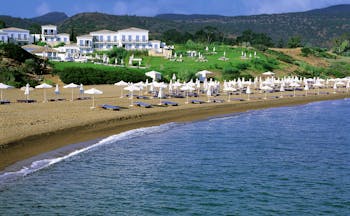
Get-away-from-it-all beaches of Mansoura and Pomos; Lara Bay and Chrysochous Bay, both with beautiful beaches on the Akamas Peninsula; cycle the flat coastal road between Polis and Pomos; the Troodos Mountains, the spiky heart of Cyprus, with a good range of waymarked trails, mountain refuges and UNESCO-protected Byzantine monasteries with superb frescoes; the Gothic castles of Buffavento and Kantara; Karpas peninsula, the island’s last real wilderness, with beautiful, abandoned beaches; the 2nd century BC Greek ruins of Salamis; the fascinating walled city of Lefkosia/N Nicosia, the only divided capital in the world; the superb Greco-Roman amphitheatre at Kourion; the quite stunning 11th century Kykkos monastery, a Byzantine gem; the Tombs of the Kings mosaics at Paphos; the ruined castle of St Hilarion, perched high in the hills of Kyrenia; Bellapais, an panoramic Augustinian monastery and one-time home of Lawrence Durrell; numerous Greek Orthodox festivals going back thousands of years.
Travel around Cyprus
Cyprus is small enough for you to get around easily. Roads are good and well signposted, and traffic moves smoothly and without the excesses and unpredictability sometimes found in other countries in Mediterranean Europe. Buses provide the only public transport on the island, and the service is pretty efficient and widespread, although no buses run on Sundays; there is no train network and no domestic air services in either the North or the South. Four-lane motorways link Lefkosia with Lemesos and Larnaka, and this network has now been expanded west to Pafos and east to Agia Napa. In Northern Cyprus, there is only one motorway, which runs between North Nicosia and Famagusta. Hiring a car will really help if you are keen to explore the best of the country. It is feasible to ride around Cyprus by bicycle along ordinary roads, which generally parallel the motorways, where cycling is not allowed. Travelling between the South and North is easy nowadays, since the restrictions on crossing the border have been eased. However, you are only allowed to cross at designated checkpoints.
Cyprus by air
We include a scheduled flight with our holidays to Cyprus from London Gatwick to Paphos Airport with British Airways. Flight time from the UK is 4 hours and 40 minutes.Our bespoke, luxury hotel holidays can be
● Single centre or multi-centre● Long or short stays
● Combine a number of different hotels in different regions
● Utilise a variety of transport arrangements to Cyprus and within Cyprus, combining flights, hire-car and private transfers
Our special interest holidays to Cyprus
● Cultural tours for individuals● Spa holidays
● Family holidays
● Watersports holidays
● Tennis and sports holidays
Included in all our holidays
● Concierge service● Handcrafted helpful hints and local information provided with all our holidays
● Personal service by your sales consultant who looks after all aspects of your holiday
Call us on 01392 441245
Our bespoke, luxury hotel holidays can be
● Single centre or multi-centre● Long or short stays
● Combine a number of different hotels in different regions
● Utilise a variety of transport arrangements to Cyprus and within Cyprus, combining flights, hire-car and private transfers
Our special interest holidays to Cyprus
● Cultural tours for individuals● Spa holidays
● Family holidays
● Watersports holidays
● Tennis and sports holidays
Included in all our holidays
● Concierge service● Handcrafted helpful hints and local information provided with all our holidays
● Personal service by your sales consultant who looks after all aspects of your holiday